Founding Story

Lumafield is building the world’s only manufacturing intelligence platform powered by industrial CT scanning. We make systems that empower engineers to see inside their products, accelerate product development, and get manufacturing right faster.

When I talk to potential investors, employees, or members of the media I’m often asked the same questions: How did Lumafield get started? Where did the idea come from? Why did I start this company?

I’ve answered this a few different ways over the years, but I’ve decided to finally sit down and write the definitive story of starting the company so I can point everyone here if they want to learn more than I can share in a couple of minutes.

1987 to 2003: Growing up next to a fab

I was born in Arlington, TX and grew up a 10-minute walk from a National Semiconductor fabrication facility. Today that building houses an Amazon distribution center. There’s an entire essay to write about what that sentence means for the past, present, and future of American manufacturing, but we’ll set that aside for now.

At the time, that fab was just a landmark in my neighborhood, not a clue about where my life was headed or the inspiration for what I would work on for the rest of my career.

2003 to 2006: Discovering physics

My parents decided to homeschool me from kindergarten through 12th grade. I spent my school years reading books from the library, playing video games, and hanging out with friends. I wasn’t a stereotypical engineering nerd as a child. I liked Lego, but I followed the instructions. When I took standardized tests to assess my learning levels I’d usually score roughly at my grade level for reading and language and below it for mathematics. No one from the current startup ecosystem would have bet on me to become a CEO if they had observed me in the early 2000s.

I became interested in engineering and science in high school when I was taking chemistry. I read a popular science book on physics over Christmas break that year to get some much-needed extra credit in the class and was instantly fascinated. Over the next three years I read every book in the Arlington Public Library catalog on physics. When it was time to go to college I wanted to major in physics, but I was worried that I wouldn’t be able to get a job after college with a physics degree, so I chose mechanical engineering instead. After growing up on the south side of the poverty line my main goal in life was to have a stable, solid-paying job after school.

2006 to 2011: A soul-crushing internship and a new plan 

I went to Baylor University for college. I chose Baylor because it 1) was a Christian school, 2) had an accredited engineering program, and 3) was a short drive from where my high school girlfriend was going to college in Dallas. In retrospect none of those three things mattered at all. Life has worked out and you can’t run the experiment twice, but I usually tell people my biggest regret was going to Baylor for college over other schools where I was admitted that had better engineering programs, like the University of Texas in Austin, or a more rigorous academic environment like Williams College in Massachusetts.

Regardless, while I was at Baylor I had a summer internship at Lockheed Martin where I discovered that having a stable, solidedu-paying job was actually a soul-crushing experience. I went back to school for my junior year extremely confused about what I was going to do with my life.

I ended up taking a class on technology entrepreneurship where I learned that it was possible to be a university professor, create new technology, and get other people—mostly the government—to fund your discoveries and help you turn them into companies. That sounded pretty good to me, so I set my sights on a PhD and a career in academia.

My grades, GRE scores, and relative class standing led the professors in my life to encourage me to set my sights low for graduate school. MIT, Stanford, and Caltech were scary places where Baylor grads smarter than me had failed. I was advised to choose one reach school in the top 10 and make sure that I went after a wide set of much safer options. I’m not sure who was more surprised when I was admitted to every school I applied to and got a NSF GRF—me or the people who had advised me. I picked my reach school, married my college girlfriend, and moved to the University of Illinois at Urbana–Champaign in August of 2011.

2011 to 2014:  My first failed company and the manufacturing bug

UIUC was a bad fit for me. The professors felt distant, the administration was frustrating, the research was narrow, and my peers mostly had ambitions to work at legacy Fortune 500 companies or become professors at nameless schools in the Midwest. Everything about the experience pushed me toward the realization that I didn’t want the life I thought I was signing up for when I went to grad school.

The only good thing about my time in Illinois was that I started a small business. Oso Technologies’ first and only product was called Plant Link. It was an internet-of-things sensor that would send you an alert when you needed to water your houseplants. If your instincts tell you that this is a bad idea, and there’s no way it could lead to a successful company—congratulations—you have better instincts than I did in 2011.

However, Oso was my first exposure to building a real product outside of a lab. We filmed a Kickstarter video with a combination of working prototypes and ID models, sold just under $100k worth of product, and were suddenly on the hook to ship 1,000+ plant sensors to people around the world.

We needed to get them manufactured and we had no idea what we were doing. I remember touring a few small manufacturing houses that wanted our business. There wasn’t much to our product—a couple of PCBAs, some injection-molded enclosures, etc. You didn’t need to be Foxconn to make Plant Link. But I was shocked by how primitive the quality control processes were at every contract manufacturer we visited. At best, they had a person look at everything with their bare eyes and make a couple of notes on some paper. At worst, the entire thing was running open loop.

It was an odd introduction to the world that I spend all of my time in today. We persevered in the face of obstacles and ran the company straight into the ground. It was a messy wind-down that had more than one false ending and culminated in a sale of the company to Scotts Miracle-Gro for less than the amount of money we raised to get the company off the ground. You live and you learn.

In this case I mostly learned two things: 1) how not to run a company, and 2) that I wanted to go work at a real startup that was solving hard problems in manufacturing instead of making gadgets for Kickstarter.

2014 to 2018: Formlabs and the limits of 3D printing

If you wanted to work on manufacturing hardware in 2014 you basically needed a reason not to end up in 3D printing. I didn’t have a reason, and I was lucky enough to end up at Formlabs, where I kicked off the development of and ultimately launched the Fuse 1 SLS 3D printer. This isn’t a blog post about Formlabs, though—you can learn more about them from the movie, their YouTube channel, or their blog. Safe to say it was—and probably still is—the highest-potential 3D printing company in the country when I joined.

Unfortunately, four years into my time at Formlabs I had a falling out with my colleagues that basically boiled down to all of us being too stuborn to figure out a way to work together despite our differences. Fortunately, it turned out that 3D printing is not actually a manufacturing technology, so leaving Formlabs gave me the chance to hit reset on my career and get back to the thing I was passionate about when I first joined the company: how real products get made, at scale.

2018 to 2019: Wandering around and obsessing over production  

I spent the next 12 months traveling around the country and the world thinking about what I wanted to do with the next decade of my life. By consulting with other startups I experimented with everything from autonomous airplanes to shoes to new 3D printing ideas. None of those things really scratched my itch to work on the problems I cared most about: how manufacturing actually works, why it’s so opaque, and why it still felt like the weakest link in the product development chain.

I would wake up in the middle of the night thinking about ways that carbon fiber layup processes, injection molding for foams, and heat-treating techniques for castings could all fail. I knew I was thinking about the right problems, but I didn't have a solution I wanted to go all in on yet.

2019 onwards: Why CT and why Lumafield

I was spent the summer of 2019 hanging out at MIT’s Center for Bits and Atoms where I was researching ways to make obscure display technologies more affordable. CBA had an incredible collection of tools including the first industrial CT scanner I had ever seen in person. I was intrigued by the idea of taking physical objects and turning them into super accurate digital representations. Almost like a reverse 3D printer.

That June I was invited was at a dinner that Onshape and Desktop Metal were hosting for hardware founders out in Burlington, MA. Ric Fulop and I were catching up after dinner when he told me that he wanted to build a CT scanner as a new product line for Desktop Metal. I said that was a bad idea—that CT scanning wasn’t close enough to 3D printing for it to be a product line, but that it might be a good idea for a standalone company.

He instantly agreed and asked me if I wanted to start that company. I was surprised and said I needed to do more research before I had an answer to that question.

Over the next couple of months I put CT scanning through the criteria list I had been using to evaluate potential ideas for the past year. Anything I was going to work on needed to check several boxes at the same time.

Industrial CT scanners are essentially X-ray machines that create 3D images of a part’s interior. Instead of just seeing the outside of a shoe sole, a turbine blade, or a battery, you can see every internal feature, every void, every defect without cutting anything open. The technology already existed, but it was slow, expensive, and locked up in specialized labs like CBA at MIT. Almost no one in day-to-day product development or manufacturing had practical access to it.

If CT could be made dramatically cheaper and simpler, it could move from a niche lab tool to something engineers and manufacturers use every day to understand and improve their products.

Here’s the checklist I was using at the time:

A solution to a big problem in manufacturing.
I wanted to work on something that mattered to how physical products get made, not just another prototyping technology like the Fuse 1, much less another gadget for the dumpster like PlantLink. 

A hard technical problem.
If you have to pick between two things to work on and everything else is equal, pick the harder one. Harder problems attract smarter people, solving hard problems is probably more valuable, and solving hard problems likely means that you have at least some kind of moat around what you’ve created.

Hardware in a market that was held back by being too expensive.
This is where I directly ripped off the Formlabs playbook. Formlabs took the technology behind a 3D printer that cost tens of thousands of dollars and made it cost a few thousand. At Lumafield we wanted to take a technology that cost $1M and make it cost closer to $100k. An order of magnitude cost reduction seemed like table stakes.

Cloud software as the core value proposition for the company.
Cloud software as a service is the greatest business model in the history of capitalism. I wanted the heart of the company to be software, even if the tip of the spear was hardware.

The ability to produce a uniquely rich dataset.
I spent much of 2018 taking online classes on neural networks. It was clear to me that the most interesting AI companies would be the ones that could generate their own proprietary data instead of training on the same public datasets as everyone else. Creating unique datasets for each of our potential customers felt like an extremely

A consumption-based business model.
I wanted usage to be directly tied to value, and I wanted a model where our best customers would naturally grow with us over time. We ended up deciding not to charge per scan so this ultimately ended up not being true, but the potential was there in the beginning. 

Something other people wanted to work on with me.
Andreas, Jonathan, Kevin, Scott, and Ric were on my literal short list of people I most wanted to work with after meeting them throughout my time at Formlabs. I knew that if I could get some of them to take a leap and work with me, I was probably onto something. Getting all of them to join in was ultimately a dream come true.

It turned out that CT scanning checked all of those boxes and more. I decided I was in. Ric and I had lunch at a sushi restaurant in Lexington, MA one day to hash out the details—equity, who was going to be CEO, etc.—and then we got to work recruiting our other co-founders, opening a bank account, incorporating the company, and calling VCs to raise money.

We had a legal entity by the end of July and our first term sheet in early August.

Since then, Lumafield has gone from a handful of people and a bank account to a company with multiple product lines, customers across a wide range of industries, and a growing team that’s still obsessed with the same problem I stumbled into at my first company: how to bring modern tools, software, and data to the invisible world inside the products that shape our lives.

As a kid, I would ride in my mom’s car past a semiconductor factory I didn’t understand. Today, I get to spend my time in factories helping the people who build products solve critical problems faster than ever before. That’s the work that Lumafield exists to do. That’s the work I’m excited to do every day when I get out of bed in the morning. 

That’s how Lumafield started. 

The rest of the story is still being written.

2023 Reading List

Even though I read less in 2023 than I normally do I still managed to squeeze a few books in here and there while sitting on airplanes, waiting for airplanes, and winding down in hotels. Business travel is the best time to read.

Here’s what I consumed this year.

Non-Fiction

Lifespan: Why We Age―and Why We Don't Have To by Dr. David Sinclair
I read this book at the start of the year when I was on a three day retreat without technology. I was in the middle of a bit of a personal crisis over my health and needed to reset a few things. Thinking about my body as a system and rebooting my base habits with longevity in mind helped pull me out of a mental spiral. I’m a long way from becoming anything approaching a specimen of physical fitness. The thinking in Lifespan helped me snap out of a pretty intense slump and for that I’ll always be grateful for this book.

Ride of a Lifetime by Bob Iger

Bob Iger has had an incredible career. It’s too bad this book doesn’t match his accomplishments. Every page felt like it was cleared with a room full of lawyers. I would love to understand the real work that went into deals as monumental as the Marvel and Star Wars acquisitions, opening new theme parks around the world, and pushing Disney into the world of streaming. Instead Ride of a Lifetime is plagued by page after page of mile wide inch deep insights that you can find in any other business book in a Hudson News.

The Kill Chain: Defending America in the Future of High-Tech Warfare by Christian Brose

February and March of 2022 were weeks where a decade worth of military technology shifts happened. Ukraine has gone on to prove that massive numbers of attritable munitions can go toe to toe with the (maybe not so) exquisite systems of the past. Go read Kill Chan if you want to understand how this philosophy could play out for the rest of the 21st century.

Team of Teams: New Rules of Engagement for a Complex World by General Stanley McChrystal

I’d like to accomplish more in life than I can do by myself so I need to be a part of a team. We’ve built a pretty great one at Lumafield, but we can be better. Most advice on how to build a team comes from people who have done it once and made a lot of money out of the process. McChrystal approaches the subject from the point of view of a leader who had to radically change his team structure in the middle of life or death stakes. Highly recommend if you want a new perspective on how to build fast paced teams.

Chip War: The Quest to Dominate the World's Most Critical Technology by Chris Miller

I studied semiconductor and micro-electrical mechanical system fabrication before dropping out of my PhD at the University of Illinois. My academic experience gave me a solid background on the theory and technology breakthroughs that drive modern integrated circuits. This book filled in many of the gaps around the social, political, economic, and business evolution that powered the days of clean room time I clocked in 2011 and 2012.

Elon Musk by Walter Isaacson

I’ll start with the obvious: judged exclusively by results Elon Musk is the greatest entrepreneur of the 21st century and it isn’t even close. SpaceX and Tesla have completely re-shaped two of the largest industries in the world and neither of them would exist in their current form without him. I’m not in love with the cloud of drama that surrounds so many of the things that Elon does, but if that is the price we have to pay for electric cars and American made space transportation than I think I can put up with a few antics every once in a while.

This book commits the sin that most contemporaneous biographies commit - it focuses far too much of the narrative on the period of time the author had with the subject. Some insane percentage of this book is dedicated to Elon’s purchase of Twitter and only a few chapters on his life in Silicon Valley before SpaceX and Tesla. Scant few details are here about PayPal or X.com. Other than that it’s a great read.

Going Infinite: The Rise and Fall of a New Tycoon by Michael Lewis

“Have you ever noticed that when someone who is incredibly accomplished in one field talks about something else it usually sounds exactly like the same conversation you have about that topic with your friends over dinner?”

Another CEO whispered that to me in the middle of the one and only time I was in the same room as SBF in late October of 2023. SBF was talking about AI or pandemics or something else – I forget what exactly he said because it was so incredibly inane. It was pretty obvious that he was not an expert in the things he was discussing. As it turns out the main thing he was an expert at was committing large scale fraud.

Michale Lewis’ book on SBF is a primer on how easy it is for otherwise impressive people to be duped when presented with a story they want to believe. If you create enough FOMO, amass a seemingly large fortune, and look like what people expect a genius to look like you can play by a totally different set of rules than the rest of society.

It’s worth taking a second to contrast SBF with Elon Musk since that’s something that seems to come up pretty frequently. I think it’s easy to tell them apart: one of them is a convicted felon and the other one has launched astronauts to space multiple times.

Thinking in Bets: Making Smarter Decisions When You Don't Have All the Facts by Annie Duke

This book is a great primer on incomplete information decision making. I found the most compelling section was at the very beginning of the book. I won’t attempt to rehash everything Duke covers here. Instead I’ll just say that I’ve been reflecting on the idea that it is possible to make bad decisions and achieve good outcomes as well as good decisions and bad outcomes. We’re trained to associate success with good decision making. In the abstract that concept makes sense – cause leads to effect. When you play a repeated game over and over again achieving one good outcome because of a bad decision means you are prone to make the same decision and under perform in the future. Thinking in Bets helped me remember not to become overly confident in success or overly depressed in failure.

How to Win the Bachelor: The Secret to Finding Love and Fame on America's Favorite Reality Show by Chad Kultgen and Lizzie Pace

If you made it this far down the list you might be surprised by this addition. I have never seen an episode of The Bachelor and I don’t plan to start soon. However, I am huge fan of the Dudley podcast and was surprised to learn that Chad Kultgen not only co-hosts one of the largest bachelor podcasts but also co-wrote an entire book on how to win the competition. Kultgen and Pace examine, explain, and define every nuance of a hugely popular reality show over the course of the book. Their description of the 1st, 2nd, 3rd, and 4th audiences that every contestant needs to keep in mind is eye opening and (sadly) relevant for anyone who is competing in a subjective world.

Generative Design: Visualize, Program, and Create with JavaScript in p5.js by Benedikt Gross, Hartmut Bohnacker, Julia Laub, and Claudius Lazzeroni

I often joke that I’m bad at the “handmade arts and crafts” part of engineering – cutting wood, welding steel, etc – so you can imagine how artistically inclined I’ve been since grade school. Digital tools are a totally different world though and I’ve loved playing around with 3D printers, CAD, and photo editing software to produce a few things for myself over the years.

I started creating generative art with Python in 2018 after leaving my last job. Scripting functions to change the color of every pixel from scratch was a rewarding challenge, but it resulted in a workflow that was hard to scale and more difficult to translate into something shareable. I found myself poking around with p5.js one day in 2021 after finally getting sick of my old stack of poorly implemented functions and never looked back.

This book has excellent examples that help an inexperienced artist like myself imagine new ways to bring my ideas to life. The Processing foundation has gone through quite a bit of upheaval this year. I hope they find a way to move past the issues in the community and continue to serve all of the great artists that use processing to express themselves.

Fiction

Devil’s Hand, In the Blood, and Only the Dead by Jack Carr

To paraphrase Dr. No, all of these books have the subtlety of a brick through a plate-glass window. They are over-the-top action movies translated into a written format. Jack Carr’s writing is easy to digest and a fun way to spend a transcontinental flight. I have as much in common with James Reece as I do with George Washington but that doesn’t stop me from enjoying the ride. 

Red Winter by Marc Cameron

The posthumous Clancy universe books are a sad shadow of his work in the 80s and 90s. I could probably re-read The Hunt for Red October each year and still enjoy it. I don’t imagine that I’ll think about Red Winter again after I finish writing this sentence

Wool and Shift by Hugh Howery

I picked up these books after watching the Apple+ series that came out this year. Without spoiling anything, Hugh Howery creates an entire society based solely in a massive underground silo. Are there plot holes and inconsistencies on every level of this story? Yes. Do I really care about that while I’m racing to find out who is going to be sent outside of the silo to clean next? Not at all.

Diamond Age by Neil Stephenson

I’m ashamed to admit that I never finished this book before this year. Our current reality is only different from the Asia-centric, fully digitally manufactured, artificially intelligent world that Stephenson constructs in Diamond Age by a matter of degrees. Even though I don’t think this matches some of his other work (Seveneves is my favorite hard sci-fi book of all time), Neil Stephenson easily cemented his place in the pantheon of the greatest sci-fi authors of all time after the hat trick of Snow Crash, The Diamond Age, and Cryptomnomicon in the 90s.

Red Team Blues by Cory Doctorow

Corey Doctorow is one of my favorite authors. He’s a tireless advocate against big tech’s bullshit, a great speaker, and a pretty nice dude from the brief interactions I’ve had with him IRL. Even though Red Team Blues felt like a pretty big departure from a few of the books that I have enjoyed the most from him (Makers and Rapture of the Nerds are must reads for anyone who works in hard tech) I still found myself enjoying it throughout. Read Red Team Blues if you want to go back to a time when crypto meant encryption instead of cryptocurrency.

That’s it!

Happy reading in 2024!

Atlas

I try to spend one day per week in a factory.

I’m either working out of our own Neptune production site here in Massachusetts or one of our amazing customer’s facilities around the USA. It doesn’t matter if the factory is making CT scanners, next generation electric vehicle components, life saving medical devices, or carbon neutral consumer products - every factory has one thing in common. They are staffed by talented, hard working, and intelligent engineers. 

But there are not enough of those engineers to go around. 

The west needs more manufacturing engineers.

Six years ago Inc interviewed Tim Cook about why Apple manufactures their most valuable products in China. The entire interview is worth reading, but two quotes have stuck in my mind since the day I first saw them.  

“In the U.S., you could have a meeting of tooling engineers and I'm not sure we could fill the room. In China, you could fill multiple football fields”

“The reason [to manufacture in China] is because of the skill, and the quantity of skill in one location and the type of skill it is.”

Western product and engineering companies are reliant on China because of the concentration of high quality manufacturing engineering talent. China doesn’t just manufacture products at scale - they train manufacturing talent at scale.

The United States and our allies can build all of the chip fabrication facilities, battery factories, and N95 mask production lines we want and we still will not be able to match China’s manufacturing capabilities unless we fix our painful lack of manufacturing engineering talent. TSMC has already delayed the opening of their new Arizona fab once due to a lack of talent in the USA. A Michelin star kitchen won’t produce amazing food without talented chefs and a manufacturing investment super cycle doesn’t mean anything without the right talent to make the factories sing. 

Lumafield is here to help. 

Today we’re proud to announce Atlas, a revolutionary co-pilot for manufacturing engineering. Atlas is a multimodal generative artificial intelligence agent that can analyze real world manufacturing data, solve your hardest engineering problems, and put the entire world’s manufacturing engineering knowledge base at your fingertips. Our vision for Atlas is as simple as it is ambitious: 10x the capacity of every design and manufacturing engineer in the west. 

Atlas is only possible because of the incredible software that our team built over the past four years Voyager. Voyager is the world's best (and only!) cloud based 3D data analysis platform. Until today Neptune has been the sole path to get data into Voyager. With the release of Atlas we’re changing that. Starting now any engineer can bring their own 3D data to Voyager and analyze it using Atlas.  You can create a free Voyager account and try Atlas for yourself right now. 

The future is going to be manufactured somewhere. Today we have a choice to make. Do we want to rely on western liberal democracies or a single totalitarian regime for the physical goods that drive our economy? Do we want the factory of the future to live in Shenzhen or in Phoenix? Do we want to invest in creating new manufacturing talent in Guangdong or in the midwest?   

I know what I want - and I hope that Atlas can help make that dream a reality. 

Build on,

Eduardo 

backlog

I am a perfectionist. I would rather leave a task unfinished than poorly done. My perfectionism is especially difficult for me because I’m quite bad at most of the things I try to do. I’m a middling artist, a mediocre cook, an inadequate software developer, a trite writer - the list goes on. 

I am also a workaholic. I once joked to a friend that my only real hobby is pursuing several different hobbies at the same time until I find something that consumes my entire life for multiple years and causes me to abandon all of my other interests. I suspect that I’m basically trying things until I find something that is interesting enough for me to overcome my perfectionism and make a push for success despite myself. Once I commit I rely on my ability to put in hard work to overcome my lack of talent. 

This potent combination of perfectionism and workaholic-isim(?) means that I leave a lot of things unfinished, unmastered, and undocumented. I tend to keep my pursuits private because my taste exceeds my ability in almost everything that I attempt. I’m embarrassed about my output in most things outside of my career. I don’t want to publish anything until the work meets the standards I set for myself. 

Instead of publishing, I live with an ever increasing backlog of projects, hobbies, and activities. My backlog haunts my weekends and holidays. Why learn something new when I’ve left so many other things unmastered and undocumented in the past? Shouldn’t I commit to one or two hobbies and thoroughly document them before moving on to other pursuits?

My mindset around this topic changed about a year ago when I decided to finally share some art that I had been creating for the previous few years. I realized through the process of creating art that I was never going to be done making art and it was foolish to wait until I reached an ever shifting goal line to share my interests with others.

So, this past Memorial Day weekend I decided to declare bankruptcy on documenting my old projects and hobbies. I’m sharing a small sampling of what I’ve been doing outside of my career for the last decade with everyone via this blog post. By writing up these micro reports I’m hitting cmd + a and then delete on my entire documentation backlog and starting over from scratch.


Mechanical Engineering PhD  

One of several thousand pictures that I took as part of my aborted PhD research

One of several thousand pictures that I took as part of my aborted PhD research

I entered the PhD program at the University of Illinois at Urbana-Champaign in the fall of 2011 and dropped out of the program in the summer of 2013 with my master’s degree. I mostly left to start a company, but I also left because I became bored with the work. Sometimes I toy with the idea of going back to graduate school and getting a PhD - but that day is not today.

Writing a book 

I have written several hundred thousand words of a few books. One of them is about my experience being homeschooled from kindergarten through my senior year of high school. Another one chronicles the story of my first startup. The third is about my time working at Formlabs. All of them are poorly conceived, badly written, and utterly incomplete. I suspect they will all remain that way. 

Autonomous vehicles  

I used tensorflow and a raspberry pi to create a semi-autonomous car as a way to figure out what all the fuss was about around self-driving cars. It turns out there’s a lot that goes into building something that can stay inside of even a simple track for more than a single lap. This video is the only documentation that I can find of that project. 

Cat robotics

I wanted to build a robot that could entertain my cat while I was at work. I stuck a laser pointer on a few servos and wrote some code to move the motors around. The ultrasonic range sensor and computer vision upgrades remained incomplete long enough that our cat passed away in the years since I started the project. Perhaps I’ll re-build something for our next cat. 

Methods for 3D printing exotic materials 

gloves = science

gloves = science

After leaving Formlabs I devised several different methods to 3D print a variety of materials that did not exist commercially at the time. The image above is a test of a method for creating feedstock for a two part reaction based printing process. I ultimately decided that the market for 3D printing companies was over saturated and I should just join another 3D printing company if I wanted to work in the space professionally again. I didn’t end up joining a 3D printing company. 

Computer vision tool sorting system for my home office 

I dusted off tensorflow to build a computer vision system inspired by the book Makers by Cory Doctorow. The system identifies an object and then lights up the accompanying panel of a peg board to tell you where the object belongs. When I moved apartments I messed up the wiring and haven’t found the interest to rebuild the whole thing again. This sweet vertical video is the best recording I have of the system working.

Software tools for generating 2D art 

I built out an entire containerized workflow for generating 2D artwork so that I could work on my projects across Mac OS, Windows, and Linux. I lost interest in the stack whenI realized I was spending more time building infrastructure than making art. 

Custom pen plotter 

2.5 axis CNC repurposed as a plotting bot

2.5 axis CNC repurposed as a plotting bot

I designed a pen plotting CNC system, built it up halfway, inherited a platform from someone at the Media Lab, used that for a few months, and ended up buying an AxiDraw so that I could stop messing with stepper motors and start focusing on drawing my creations. I’m not going to build my own platform any time soon.

Hiking 

A mountain near Chamonix, France

A mountain near Chamonix, France

I started hiking in the summer of 2017. Ended up bagging a dozen different peaks in New Hampshire, Colorado, France, and Switzerland that year. The summer of 2018 was filled with weddings, I started a company in 2019, and last year I stayed home thanks to a large number of obvious reasons. Hope to get back in the mountains again soon, but I won’t force myself to surpass my previous accomplishments on day one.

SCUBA diving 

sea turtle off the coast of Honduras

sea turtle off the coast of Honduras

I became SCUBA certified in 2016 and dove each summer for the next few years. I’ve been on diving trips to Honduras, Mexico, and Thailand. I decided to stop pursuing the hobby briefly after getting stung by a stingray in the summer of 2018 and haven’t made it a priority since then. It would be great to dive again in the near future.

Photography 

train tracks near Tacoma, WA

train tracks near Tacoma, WA

I took an online course on photography one summer and ended up purchasing a used Sony Alpha 7 III to try to get better at the practice.  I used it for a weekend and decided that I didn’t want to lug a big camera around all the time. Since then my photography has been limited to what I can snag with my iPhone. I haven’t published much of it before now, but you can take a peek at my new photography page to see more. 

Cooking 

Homemade lasagna

Homemade lasagna

I love cooking and have been steadily improving my skills in this area for the past few years. I’ve developed a couple of different recipes but have mostly stuck to cooking dishes that other chefs have developed. I took a few minutes and documented some of the recipes I’ve enjoyed on my new cooking page. Maybe I’ll update that page with new recipes someday, or maybe not.


My hope is that by sharing these unfinished projects and unperfected hobbies I will clear out that mental backlog that I’ve felt for several years and free myself to pursue whatever I want to in my limited free time going forward.

Why should I feel guilty over undocumented personal projects when I could be spending  time enjoying what I’m doing for the sake of doing and not worry so much about perfectly sharing the outcome?

Life is too short to waste it worrying about a backlog.

fundamentals

There’s understandably a lot of hand wringing going on around what offices and teams will look like once we cross the finish line on the pandemic and start to adapt to some kind of new normal. I’ve seen countless versions of the same lists, articles, and blog posts about this topic for the past year. Most people writing and speaking on the topic tend to focus on software tools, schedules, commutes, upcoming startup hub cities, and any other number of topics when asked about what the world will look like in 18 months. 

I’ve avoided talking about this subject until I was asked about it point blank this afternoon during a panel I was on with MIT’s Enterprise Forum. Instead of studying what startups, Fortune 500 companies, or FAANG businesses are doing to address the situation I encouraged the attendees to look at a very different source of inspiration: Pablo Picasso. 

Most people probably conjure up an image of something like Guernica, The Old Guitarist, or Les Demoiselles d'Avignon when they hear Picasso mentioned. Distorted figures in other worldly scenes, cubism, that kind of thing.

You know, standard run-of-the-mill art movement defining stuff.

You know, standard run-of-the-mill art movement defining stuff.

When I think of Picasso I think of the same paintings, followed quickly by the amazing Kanye West album, followed instantly by Science and Charity.

Not exactly Guernica

Not exactly Guernica

Science and Charity is not your typical Picasso masterpiece. It was painted during his early training when he was 15 or 16 years old and looks completely different from his later works. It does not break all of the established rules of painting and establish a totally new paradigm. On the contrary, it shows a mastery of the basic principles of painting. 

Why am I giving you an art history lesson in the middle of a blog post about the future of work? Because I think the same principle that applied to Picasso’s career applies to workplaces and company cultures. 

The next five years will be full of case studies of companies with bad workplace cultures applying the hottest hybrid workplace trends to their companies and ending up with a slightly different (but still bad) cultures. If your team can’t write well,  keep email threads tight,  use messaging systems without distractions, or make compelling presentations for internal or external audiences before you adopt a hybrid workplace model, what makes you think they will be good at these things from home? 

In the end I’d encourage every company to ignore all of the blog posts and conferences on the future of work and instead spend their time taking a writing seminar to improve the quality of their communication skills first. 

Be like Picasso.

Master the basics before you break the rules.

artist

I am an artist. 

It’s a strange thing to say. I’ve never identified myself as an artist until recently. It’s still not in the top 10 or maybe even 20 ways I’d think to introduce myself, but it’s still true. 

When I was in elementary school I decided that I was bad at drawing. Anything less than photorealistic sketching wasn’t really art, so why try? Teasing from other kids about my inability to draw stick figures didn’t help either. I stopped drawing and never looked back. 

Despite my choice to go down another path in 1995 there are three people who acted as Virgils during my journey to where I am today. 

The first is my mom. 

My mom loves art. She home-schooled all four of her children from kindergarten through the 12th grade and never passed up on an opportunity to take us to one of the art museums in the Dallas-Fort Worth area where we grew up. Even though I didn’t appreciate it at the time I grew up walking through galleries  looking at works by Monet, Picasso, Matisse, Mondrian, Cezanne, and others. Later on in high school the Ft. Worth Museum of Modern Art opened and introduced me to more abstract works that included sculpture, electronic installations, film, and prints. By the time I left for college I enjoyed going to museums and perusing collections - I just had no idea about the context or meaning behind what I was looking at and viewed art in purely aesthetic terms. I was one of those people who would look at an abstract work and say “It doesn’t look like anything to me”. At least it was a start. 

Visiting the Museum of Fine Art in Boston, MA with my mom in 2016. She still loves art.

Visiting the Museum of Fine Art in Boston, MA with my mom in 2016. She still loves art.

The second Virgil was Dr. Katie Robinson. 

Dr. Robinson taught Art 1300 at Baylor University during my final spring semester. Looking back I’m not totally sure why I signed up for Art 1300. I didn’t need the GPA boost, I didn’t need any more courses to graduate, and I didn’t need any more hours to be a full time student that semester. I think I must have done it because it felt like the kind of class that you should take in college to have a complete education experience.

Whatever my reasoning or expectations were going into the class my Art 1300 professor Dr. Robinson completely blew them out of the water over the following semester. I could go on and on about Dr. Robinson. The one thing that she impressed on me above everything else is the concept that context is a crucial part of any work of art. You can’t fully understand or appreciate a work of art without understanding the set of conditions that lead to its creation. This context includes everything from materials and methods to global politics and local artistic movements.

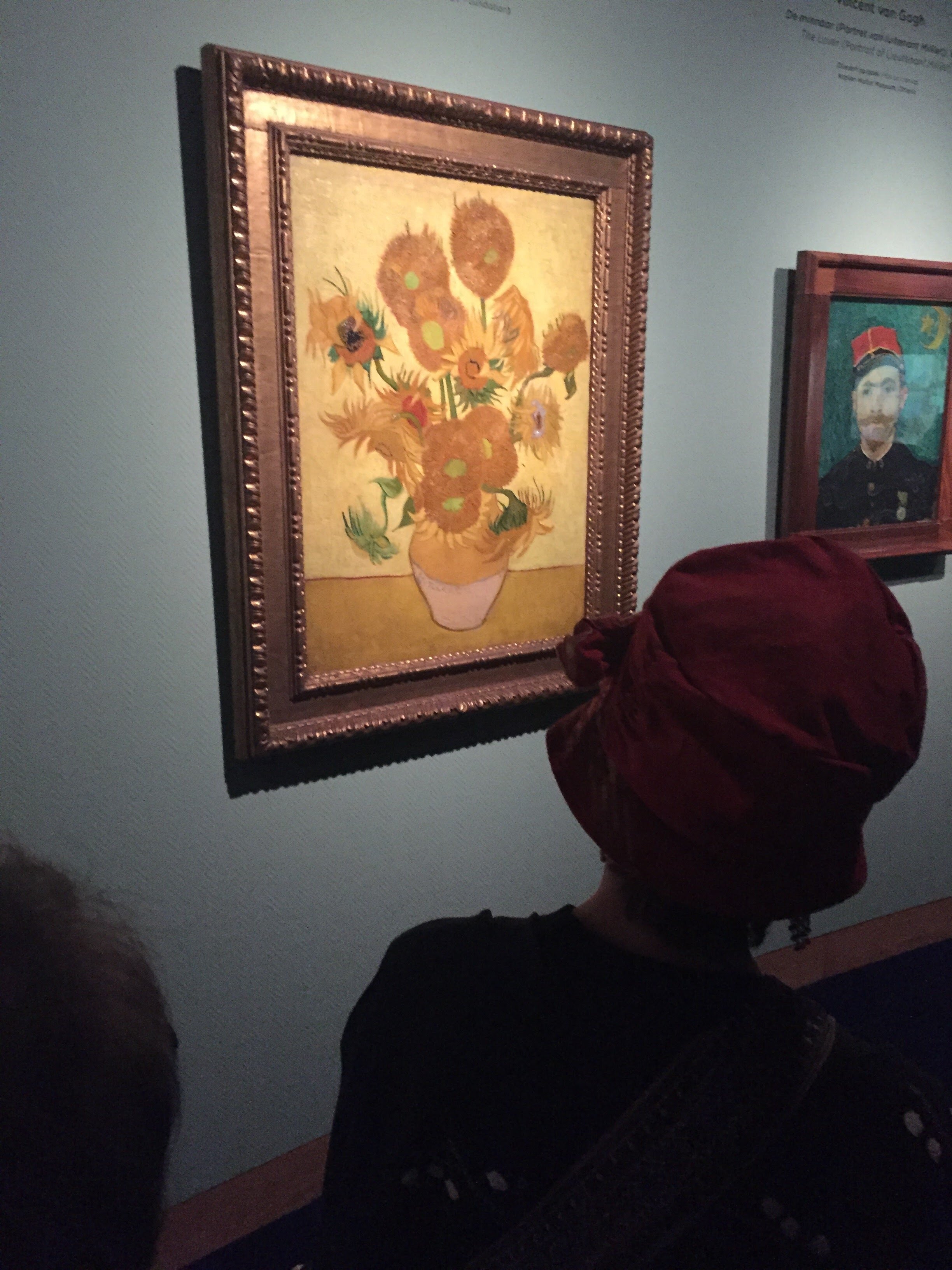
Suddenly art was a lot more interesting. I started seeking out art museums more actively. Over the next few years I’d visit museums across the US and around the world. I’d constantly wonder about and look up more information on the context that created the works in front of me. Life was richer for the time that I spent in art museums.

The only photo I managed to snap in the Monet museum in Amsterdam before a security guard yelled at me.

The only photo I managed to snap in the Monet museum in Amsterdam before a security guard yelled at me.

Every once in awhile I’d contemplate making art myself. I was always busy with something else though. If that wasn’t enough, the voice of elementary school aged Eduardo would whisper in my ear and remind me that I wasn’t good enough with a pencil/pen/etc to attempt to make art and that would be the end of that. 

The third and shortest lasting Vrigil was Sol LeWitt. 

2018 was a rough year for me. Without going into too much detail (a blog post for another decade perhaps) I found myself in the position to take several months off from my professional career. I decided to spend part of this time driving a convertible up the west coast of the USA from San Diego, California to Whistler, British Columbia. In the lead up to that trip I stumbled across an article online that referenced a famous letter Sol LeWitt wrote to Eva Hesse in 1965. I won’t attempt to summarize his writing here. The crux of the piece is LeWitt’s exhortation to put aside your doubts and DO. 

Unsurprisingly perhaps the letter is itself a work of art. You can read it in full here and even listen to a dramatic reading by Benedict Cumberbatch.

Unsurprisingly perhaps the letter is itself a work of art. You can read it in full here and even listen to a dramatic reading by Benedict Cumberbatch.

With weeks of uncommitted time ahead of me and nothing to distract me I decided to heed LeWitt’s words and make some art for the first time in 20 years. I still couldn’t draw so I chose the python programming language as my medium. I’m only a slightly better programmer than I am a draftsman. Given the circumstances I’ll take what I can get.  I challenged myself to create a new piece of art every other day for several months and more or less succeeded. 

One of my works from the first six months of making art.

One of my works from the first six months of making art.

Over the course of my journey I stopped in at every major art museum and public gallery on the west coast and spent hours wandering their wings. I fell in love with works by Mondrian, Rothko, Kline, Pollock, Noll, and (of course) LeWitt. Every time I saw something I particularly enjoyed I’d attempt to recreate it in python using the library of functions I had developed over the preceding weeks. 

Recreation of the 7th wall in Sol Lewitt’s Wall Drawing 273 on display at SFMOMA in the fall of 2018.

Recreation of the 7th wall in Sol Lewitt’s Wall Drawing 273 on display at SFMOMA in the fall of 2018.

Along the way I decided to get over my fear of artistic criticism and started sharing some of my pieces anonymously with strangers on the internet. Despite my fears I never encountered any haters in the few months I was actively engaged with the online art community. I mostly didn’t encounter anyone - a big step up from elementary school. I’ve covered most of those tracks pretty carefully. However, you can still see some of the work from this period on the infrequently updated Instagram page I made during my trip. 

When I finally got home and went back to work I resolved to keep making art. From time to time I’ve added a few other tools to my tool box beyond my collection of python scripts. These days I mostly create new pieces when I’m traveling. Airplanes are great places to write code and make art when you aren’t sheltering in place in the middle of a global pandemic. My apartment is a decent second choice for all those times when you are sheltering in place in the middle of global pandemic. 

Most recently I’ve created a page on this website to share some of my art as well. You can check it out here. I hope you enjoy some of my work. 

I’ll be the first person to admit that my art is not good. My techniques are flawed, my methods are simplistic, I straight up do not understand how to use color, and I am inconsistent in my practice. 

But you don’t have to be a good artist to be an artist. You don’t have to impress anyone else. 

You only have to create art to be an artist. 

You just have to do.

chrome

I love chrome’s search engine management features. If you spend a lot of time in chrome + google drive/docs/etc and you aren’t already using the following shortcuts you might enjoy trying this out:

  1. Chrome > Settings > Manage search engines

  2. Other Search Engines > Add

  3. Name the search engine whatever

  4. Choose a keyword that you want to type into the address bar to launch the webpage

  5. Use whatever URL you want to access in the URL field

  6. Hit Add and enjoy a new level of productivity


For example, I have my browser setup with the following:

“doc” launches https://docs.google.com/create

“slide” launches https://slides.google.com/create

“sheet” launches https://sheets.google.com/create

typing “d” and then hitting space lets me search my google drive from my address bar instead of navigating to the drive page.

It’s not a huge change, but I think it vastly improves using all of these services.

Any other browser based productivity improvements that I should know about?

leap before you look

This is one of those obligatory life update blogs after a long absence. I’ll keep it brief:

I’m leaving Formlabs on July 20th

Not a lot to say here right now, but after talking with family and friends I’ve decided to leave Formlabs and find my next career adventure. More thoughts on this in the weeks to come. I’m going to have a lot more time to blog soon because…

I’m taking a break from full time work until September

One of my biggest professional regrets is not taking more time between wrapping up things with PlantLink and joining Formlabs. This time I’m going to take it nice and slow with at least a month (and probably more) off between full time work commitments. To fill that time…

I’m driving from San Diego to Vancouver!

I’ve always wanted to road trip it up the west coast and this seems like the perfect opportunity to make it happen. If you are going to be on the west coast between July 28th and early September hit me up and let’s hang out. I especially want to talk to you if you are working at a startup, doing anything interesting with hardware, or like to hike incredibly slowly.

More blogging to come.

what goes up

The summer of 2014 started out with a lot of potential. My business wasn't in the best shape, but I was hopeful that our pivot into commercial agriculture might end up saving us from going under. I gave a talk about our plan to a few people at the first Solid conference in San Francisco. 

In retrospect I can see that I was wrong about almost all of the points I made about the future during that talk. I was making the best projections I could with the information that I had, but it was incomplete and based on a few false assumptions. By the end of the summer my company went under and I spent the next few months shutting down the business. 

A year later I had the opportunity to give a talk about how my company failed. I was able to return to the Solid stage and talk about some of the lessons that I learned along the way. My talk about failure was roughly four times longer than my first talk. (I still feel bad about running long and cutting into Ian's time. Sorry Ian) (I also committed the cardinal sin of video presentations and didn't repeat questions into the mic. Sorry everyone.) 

Writing and giving my second talk was a very cathartic experience. It was really helpful for me to get the story of Oso Technologies off of my chest. I enjoyed the chance to share my own experiences with a group of people who were clearly very interested in not repeating the mistakes that I had made. 

I'm finally releasing this video to what I assume is a pretty small audience at this point. Maybe someday I'll be able to point people to it, but for now I'm just happy to have it out there.